Thursday, 26 January 2017

THEORY OF NARRATIVE

THEORY OF NARRATIVE

Who is Tzvetan Todorov ?

Image result for todorov


--> He was born on the 1st of March 1939, in Sofia, Bulgaria

--> He is a Franco - Bulgarian Philosopher

--> Lived in France since 1963

--> Wrote several books and essays about "Literary Theory", "Thought History" and         "Culture Theory"

--> Published a total of 21 books

--> He was a visiting professor at a large number of universities, including Harvard          University in Cambridge, USA

--> Todorov's historical interests have focused on issues such as the Conquest Of             The Americans and  the Nazi and Stalinist concentration camps 

Todorov's Theory Of Narrative


Todorov's narrative theory states that stories begin with an equilibrium where any potentially opposing forces are in balance and that this equilibrium is interrupted by a series of events. Problems are solved so that the order can be restored to the world of the fiction. 


Todorov claimed that conventional narratives are structured in 5 different stages.


1 - Equilibrium 


The first part of the story will display a very happy start, where basically the majority of the of characters are content and everything is totally fine as it should be. 

Image result for shrek

2 - Disruption 

The second part of the story will feature a problem or somewhere where some thing will disrupt the peaceful state of balance.
Image result for shrek witch

3 - Recognition 

This part of the plot is when everyone realises there is a problem and there's a lot of chaos. 

Image result for shrek dragon fighting

4 - Attempt to restore the Disruption 


This part of the plot is when the characters attempts to repair the damage which is/was done and tries to restore the problem. 


5 - A reinstatement of the Equilibrium 

This is the final part of the plot where the problem is resolved and the normality can resume again.

Image result for fiona and shrek wedding


                   In this 5 stages, the narrative is not seen as a linear structure but a circular one, driven by attempts to restore the equilibrium.


TARGET AUDIENCE RESEARCH DEMOGRAPHICS

THE DEMOGRAPHICS


Thanks to this secondary quantitative data that I have found through my own research and many investigations, I have been able to figure out what my target audience is in Horror movies. There is a 42% men and 58% women split. There is not a great disproportion of the two genders watching Horror movies so what I am aiming to do is to produce a horror movie opening that can relate to both genders not just one. EQUALITY.

As shown in the table, we can see that our target audience that watches Horror movies falls in the age rank of 18 year olds to 24 years olds for a huge number of reasons that might include easy access to money via work, parents, even spare time and many more or access to 18+ horror movies in theatres or whatever other reasons might there be.


My in-progress Horror movie opening, is generally aimed at any mixture of multi-ethnical background however statistics are showing unstable trends of people of different Ethnicity watching horror movies, but as I previously mentioned, my movie won't be biased, it will be open to any person who wants to watch it.


Friday, 20 January 2017

LIGHTING

PLANNING : LIGHTING


The intensity, direction, and quality of lighting have a profound effect on the way an image is perceived. Light affects the way colours are rendered, both in terms of hue and depth, and can focus attention on particular elements of the composition. Much like movement in the cinema, the history of lighting technology is initially linked to the history of film style. Most mainstream films rely on the three point lighting style, and its genre variations. Other films, for example documentaries and realist cinema, rely on natural light to create a sense of authenticity.


High Key:


High key lighting is a style of lighting that is bright or equally even in the concept and produces little contrast between light and dark areas of the scene having chiefly light tones. Usuallywith little tonal contrast having a predominance of light grey tones or light colours. It also refers to images that are mostly bright with a range of light tones and whites and not very many blacks or mid tones.  In high-key photography, tones that generally would have been mid-range become much brighter, near-white tones become white and white becomes, well, white. This style of lighting was originally developed for films and television, back when the technology wasn’t very good at capturing high contrast ratios. Today high key is purely an artistic decision – photographers and filmmakers choose it when they want an image or story to be upbeat, optimistic or youthful. 


Low Key:


Low key lighting is the complete opposite to High key lighting. The Low lighting is a style for photography, film and television. It is a necessary element in creating a chiaroscuro effect. Its is used optionally controlled with a fill light or a simple reflector. Also, Low key light accentuates the contours of an object by throwing areas into shade while a fill light or reflector may illuminate the shadow areas to control contrast. The term "low key" is used in cinematography to refer to any scene with a high lighting ratio, especially if there is a predominance of shadowy areas. It tends to heighten the sense of alienation felt by the viewer, hence is commonly used in film noir and horror genres.


Differences between High and Low Key Lighting:


High-key lighting focuses on light tones and whites; low-key lighting relies on shadows, deep blacks and darker tones, with very few whites and middle tones. The mood is quite the opposite, too – while high-key lighting is hopeful and very optimistic, low-key lighting is somber, mysterious and moody, dramatic or even ominous, upsetting depending on the subject. High-key images are more flatter with less contrast than an image that qualifies as mid-key, which is most of the images that photographers produce. Low key images, on the other hand, tend to have a lot of contrast, with the primary impact coming from the shadows. Both High Key images and Low Key images make an intensive use of contrast, but in a very different way. When approaching a shoot of a dramatic portrait, the decision of making it a High Key, Low Key has great impact about the mood that this picture will convey. While High Key images are considered happy, joyful and that they will show your subject as a tooth-paste poster; Low Key portraits are dramatic and convey a lot of atmosphere and tension. 


Wednesday, 18 January 2017

CAMERA SHOTS AND ANGLES

PLANNING: CAMERA SHOTS AND ANGLES


In movies, we might not notice but there are a set of techniques used for us to understand better the meaning of a scene. For this, Camera Shots and Angle Shots are being used.
You might wonder what camera shots and angle shots are, well here are the explanations;

A camera shot is the amount of space that is seen in one shot used essentially to demonstrate different aspects of a film's setting, characters and themes. On the other side, a camera angle is simply the position in which the camera is held. For a better understanding of Camera Shots and Camera Angles, we've included pictures with the many different camera shots and angles.


This is an EXTREME LONG SHOT. It usually contains a large amount of landscape. It is often used at the beginning of a scene or film to establish general LOCATION (setting).It normally shows an EXTERIOR, eg the outside of a building, or a landscape, and is often used to show scenes of thrilling action eg in a war film or disaster movie.


This is a LONG SHOT. It gives the viewer a more specific idea of setting. A long might show the viewers the building where the action will take place. 


This is a LONG SHOT. It gives the viewer a more specific idea of setting. A long might show the viewers the building where the action will take place. 


This is a MEDIUM SHOT. It contains characters from the waist up so that the viewers can see the characters' faces more clearly as well as their interaction with other characters.


This is MEDIUM CLOSE-UP. It is half way between a medium shot and a close up, it contains characters from mid bust to head.


This is a CLOSE-UP. It contains just one character's face, so that viewers can understand the actor's emotions and feel empathy for the character.


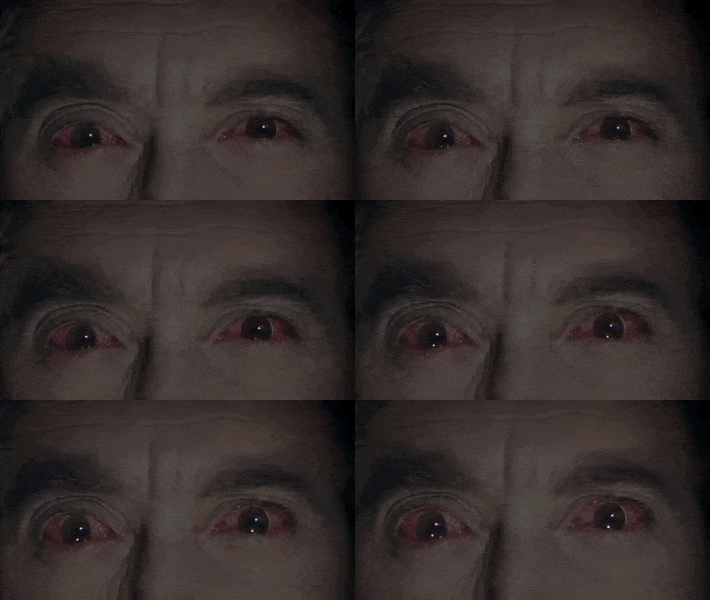
This is an EXTREME CLOSE-UP. It contains one part of a character's face. This technique is quite common in horror films. This creates an intense mood and provides interaction between the audience and the character.


This is a HIGH ANGLE. It looks down upon a subject. A high angle makes the character look vulnerable or small.


This a LOW ANGLE. It looks up at a character. This is the opposite of a high angle and makes a character look more powerful.